

Why Your North Texas Yard Holds Water: French Drains vs. Channel Drains vs. Sump Pumps
Published at June 30, 2026 | Category: Sump Pump
If your lawn turns into a shallow pond every time a storm rolls through, you are not doing anything wrong as a homeowner. You are fighting the ground itself. Across Plano, Frisco, McKinney, Sherman, Denison, and the rest of Collin and Grayson County, most homes sit on heavy clay that simply will not let water soak away fast enough. The rain has nowhere to go, so it sits on the surface and creeps toward the lowest point in your yard, which is often your foundation.
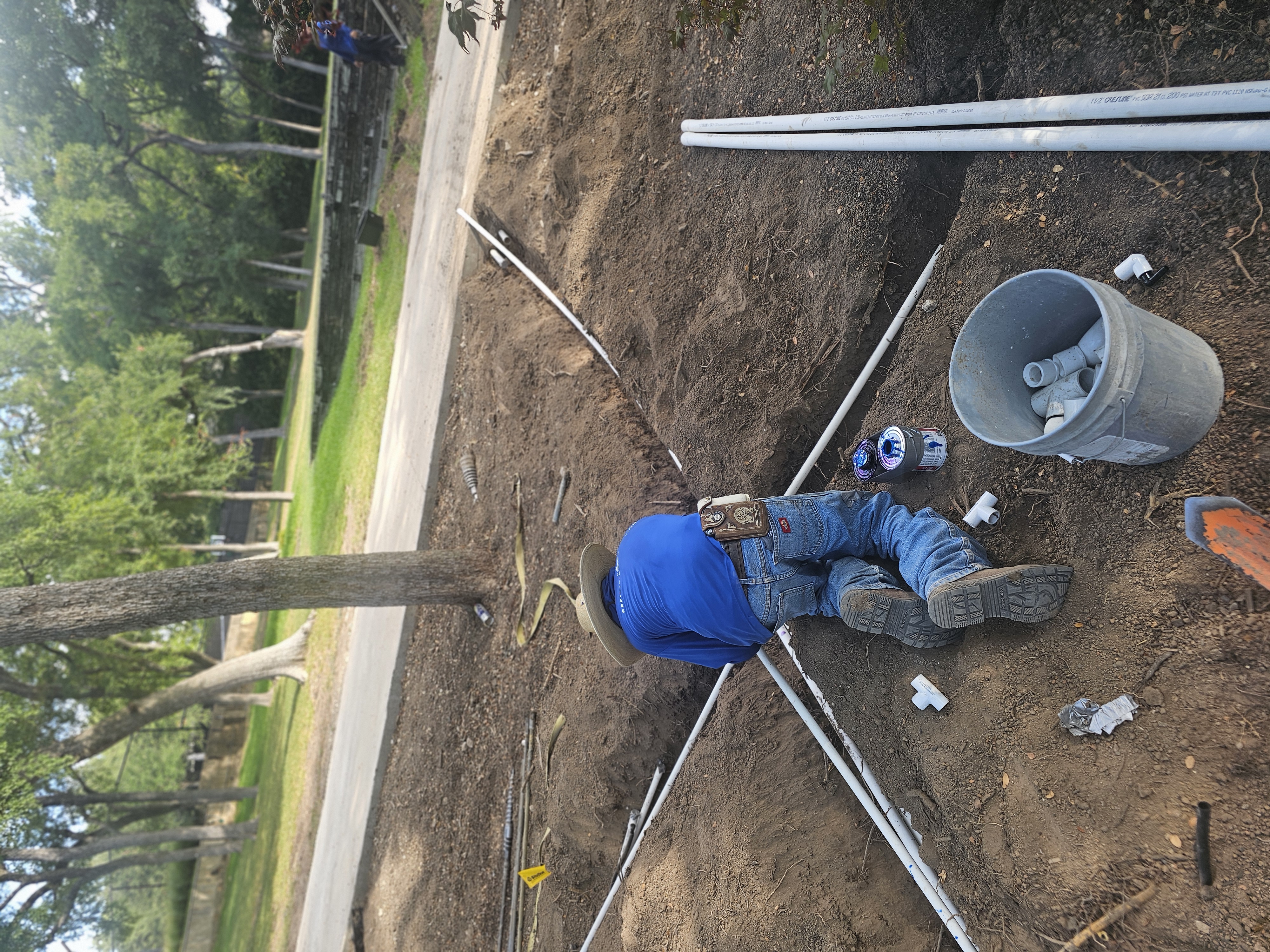
The good news is that standing water is a solvable problem. The three most effective tools for North Texas yards are French drains, channel drains, and sump pumps, and each one is built for a different kind of water. Choosing correctly is the difference between a fix that lasts for years and a trench that fills back up after the next thunderstorm. This guide breaks down how each system works, where it wins, and how to tell which one (or which combination) your yard actually needs.
North Texas yards hold water because most of Collin and Grayson County sits on Blackland Prairie clay, a dense soil that barely absorbs rain. The fix depends on where the water shows up: a French drain pulls water out of soggy, saturated soil; a channel drain or catch basin captures fast surface runoff off driveways, patios, and pool decks; and a sump pump removes water trapped in a low spot that has no downhill outlet. Many local yards need a combination of the three.
Why Does Water Pool in North Texas Yards?
Water pools here mainly because of the soil. Most of the Dallas-Fort Worth area, including Collin and Grayson County, sits on the Blackland Prairie, a band of dark, expansive clay often nicknamed black gumbo. This clay has an extremely low infiltration rate, which means rain cannot move down through it quickly. Instead of soaking in, water backs up and spreads across the surface.
Three local factors make it worse:
- Expansive clay that swells and shrinks. Blackland Prairie clay can swell significantly when saturated and shrink as it dries, so the ground is constantly moving and rarely drains evenly.
- Flat suburban lots. Many newer North Texas developments are graded for appearance rather than drainage, leaving yards with very little slope for water to follow.
- Compacted soil from construction. Heavy equipment compresses the clay during building, which lowers its already poor ability to absorb water.
Layer on top of that the local weather pattern, which swings between heavy spring rains and long, dry summers, and you get soil that is either too wet to absorb a downpour or too hard and cracked to take water in at all. You can confirm the soil type under your own address using theUSDA Web Soil Survey, a free federal tool that reports drainage class and shrink-swell potential by location.
How Standing Water Affects Your Foundation and Landscape
In most parts of the country, the concern with yard water is the basement. North Texas is different. Homes here are overwhelmingly slab-on-grade, so the real issue is what standing water does to the clay around and under that slab.
Because Blackland Prairie clay expands when wet and contracts when dry, water that pools on one side of a home swells that soil while drier soil on another side keeps shrinking. That uneven movement is what stresses a slab foundation over time and shows up as hairline cracks, doors that stick, or floors that no longer feel level. Texas A&M’sAgriLife Extension guidance on foundation watering makes the same point from the other direction: keeping soil moisture consistent is one of the most effective things a North Texas homeowner can do for their slab.
Beyond the foundation, sitting water kills grass, drowns plant roots, invites mosquitoes, and erodes soil and mulch. Moving that water off the surface and away from the house, rather than letting it linger, is the whole goal of a drainage system. For a fuller breakdown of options, ouryard drainage solutions overview walks through how the pieces fit together.
French Drains: How They Work and When They Win
A French drain is a buried, gravity-fed trench. It is filled with washed gravel, lined with a non-woven geotextile fabric, and built around a perforated pipe that collects water underground and carries it to a lower discharge point. Once it is covered with soil and sod, you cannot see it.
Where French drains shine
- Soggy, spongy lawns where the soil stays saturated for days after rain.
- Subsurface water and seepage that wells up rather than rushing across the surface.
- Redirecting groundwater away from the foundation along the perimeter of a home.
The North Texas catch
A French drain depends on water reaching the pipe through the surrounding soil and gravel. In dense Blackland clay, that movement is slow, and a fast, heavy downpour can overwhelm a buried drain before the water has time to seep in. That is why a French drain in our area has to be built correctly: wrapped in quality fabric so clay fines do not clog it, set at the right slope toward a true daylight outlet, and sized for the wet area it serves. Done right, it is a durable, low-maintenance, no-power solution. Done as a cheap pipe dropped in loose gravel, it becomes a buried failure within a season or two.
Learn more about how we build these systems on ourFrench drain installation page.
Channel Drains and Catch Basins: Best for Surface Water
Where a French drain works underground, a channel drain works right at the surface. It is a long, narrow trench topped with a grate, usually set into concrete along a driveway, patio, pool deck, or garage apron. A catch basin is its cousin: a boxed inlet with a grate placed at a low collection point where several slopes meet. Both capture water the instant it appears and route it into a pipe.
Where channel drains and catch basins shine
- Sheet water racing off hard surfaces like driveways, patios, and pool decks.
- Water running toward a garage door, entryway, or low threshold.
- Low spots in the yard where runoff from multiple directions collects.
This is often the unsung hero of North Texas drainage. Because our clay absorbs so little, a great deal of storm water never goes underground at all, it simply runs across the surface looking for a low point. A surface drain gives that water an immediate entry point before it can reach your slab. For many local properties, channel drains and catch basins solve the problem that a buried drain alone cannot. See ourchannel drains and catch basins page for installation details.
Sump Pumps: When Gravity Is Not Enough
French drains and channel drains both rely on gravity, which means they need somewhere lower to send the water. On a flat lot, that lower outlet sometimes does not exist. This is where a sump pump earns its place.
A sump pump system collects water in a basin set at the lowest point of the problem area. When the basin fills, the pump switches on and pushes the water up and out through a discharge line to a safe location, well away from the foundation. It is an active, capture-and-eject system rather than a passive, capture-and-redirect one.
Where sump pumps shine
- Flat yards with a persistent low spot and no downhill path for a gravity drain.
- Areas where water has to be lifted up and over a grade to reach a safe outlet.
- Properties that need to move a large volume of water quickly during heavy storms.
The trade-off is that a sump pump has moving parts and needs electricity, so a power outage during a storm is a real consideration. A battery backup solves that for critical installations.
Details on our approach are on thesump pump installation page.
French Drains vs. Channel Drains vs. Sump Pumps: Side by Side
Most online comparisons stop at two systems and assume you have a basement. North Texas yards need the full picture. Here is how the three solutions stack up for a slab-on-grade home on clay soil:
| Factor | French Drain | Channel Drain / Catch Basin | Sump Pump |
|---|---|---|---|
| Best for | Saturated, soggy soil and groundwater | Fast surface runoff on hard surfaces | Trapped water with no gravity outlet |
| How it works | Buried perforated pipe in gravel, gravity fed | Surface grate captures water instantly | Basin collects water, pump ejects it |
| Visibility | Hidden under sod or rock | Visible grate at surface | Basin lid plus discharge line |
| Needs power | No | No | Yes (battery backup optional) |
| North Texas fit | Strong if built for clay with proper fabric and slope | Often the top performer given low soil absorption | Essential on flat lots with no daylight outlet |
| Maintenance | Low; periodic outlet cleaning | Clear grate and basin of debris seasonally | Test pump and check valve regularly |
Which Drainage Solution Is Right for Your North Texas Yard?
The fastest way to narrow it down is to look at where the water shows up and how it behaves. Match your symptom to the system:
- The ground stays soggy for days. If your soil is spongy and slow to dry well after the rain stops, the problem is saturation. A French drain is usually the right call.
- Water sheets off a driveway, patio, or pool deck. If you can watch water race across a hard surface during a storm, you need to catch it at the surface. A channel drain or catch basin is the answer.
- Water pools in one low spot and just sits. If there is no lower ground for water to flow to, gravity drains have nowhere to send it. A sump pump moves it out.
- You have more than one of these. Most North Texas yards do. The best result often comes from a combined system, such as catch basins feeding a buried line that daylights at the property edge, or a basin with a pump where the lot runs flat.
Because the right answer depends on slope, soil, and where water can legally be discharged, a quick on-site evaluation saves money in the long run. A drain matched to the wrong problem is the most expensive option, because the water keeps coming back. Ourcomplete yard drainage systems combine these tools into one plan built for your specific property.
Not sure which system your yard needs?
The team at Efficient Irrigation Systems will walk your property, find where the water starts, and recommend the simplest fix that solves it. Call 469-825-3909 (Collin County) or 903-213-2757 (Grayson County), orrequest service online.
How Efficient Irrigation Systems Approaches Drainage
Efficient Irrigation Systems is a locally based irrigation and drainage contractor serving Collin and Grayson County, including Plano, Frisco, McKinney, Allen, Prosper, Sherman, Denison, and the surrounding communities. Drainage is one of our core services alongside sprinkler repair and installation, so we look at how water and irrigation work together across the whole yard, not just one trench.
Our process is straightforward:
- We evaluate the property to find where water originates, how it moves, and where it can safely go.
- We identify the soil and slope conditions that drive the problem.
- We recommend the simplest system, or combination, that solves it for the long term.
- We install with quality pipe, proper geotextile fabric for clay, and a correct, verified slope to a safe discharge point.
We are licensed and insured, and irrigation work in Texas is performed under a licensed irrigator, so the system is built to code and built to last. You can read verified homeowner feedback and leave your own on ourGoogle review profile. To understand how proper drainage protects against stormwater problems more broadly, theEPA’s guidance on managing stormwater runoff is a useful read.
Stop Fighting Standing Water in Your Yard
A yard that holds water is not just an eyesore, it is a slow source of stress on your landscape and your slab. The right drainage system, matched to the way water actually moves across your property, ends the problem for good.
Ready to dry out your yard? Efficient Irrigation Systems designs and installs French drains, channel drains, catch basins, and sump pumps across Collin and Grayson County. Licensed, insured, and local. Call 469-825-3909 (Collin County) or 903-213-2757 (Grayson County), orcontact us online to schedule your drainage assessment today.
Frequently Asked Questions (FAQs)
Why does my North Texas yard hold water after it rains?
Most of Collin and Grayson County sits on Blackland Prairie expansive clay, which has a very low infiltration rate. Rain cannot soak in quickly, so it collects on the surface and pools in low spots. Flat suburban lots, compacted soil from new construction, and downspouts that empty next to the slab make it worse. The fix is a drainage system that moves water off the surface and away from the foundation, since the soil itself will not absorb it fast enough.
Do French drains work in Blackland Prairie clay soil?
Yes, but they have to be designed for clay. A French drain relies on water reaching the perforated pipe through surrounding gravel, and dense clay resists that movement. In North Texas, a French drain works best when it is wrapped in non-woven geotextile fabric, set with the correct slope toward a daylight outlet, and used for subsurface or saturated-soil problems rather than fast surface runoff. For sheet water racing off a patio or driveway, a surface channel drain often performs better.
What is the difference between a French drain and a channel drain?
A French drain is a buried gravel trench with a perforated pipe that collects water below the surface and is hidden under sod or rock. A channel drain is a surface trench with a grate, usually set into concrete along a driveway, patio, or pool deck, that captures water the instant it appears. French drains manage soggy soil and groundwater. Channel drains and catch basins manage visible surface runoff on hard surfaces.
Do I need a sump pump if my yard is flat?
Possibly. A sump pump becomes the right answer when water collects in a low area that has no gravity outlet, which is common on flat North Texas lots where a French or channel drain has nowhere lower to drain to. The pump moves water from a collection basin up and out to a safe discharge point. If your yard does have enough fall to reach a lower outlet, a gravity-fed drain is usually simpler and needs no power.
Can standing water really damage my home’s foundation in North Texas?
It can, because of how local clay behaves. Blackland Prairie clay swells when wet and shrinks when dry. When water pools on one side of a slab, that soil expands while drier soil elsewhere contracts, and the uneven movement stresses the foundation over time. Keeping moisture consistent and moving standing water away from the slab is one of the most effective ways North Texas homeowners reduce that risk.
Which is cheaper: a French drain, a channel drain, or a sump pump?
Cost depends on the size of the wet area, the soil, the slope, and the discharge route, so the right comparison is fit rather than sticker price. A drain matched to the wrong problem is the most expensive option because the water keeps coming back. The most reliable way to control cost is a site evaluation that identifies where the water starts, how it moves, and where it can safely go, then chooses the simplest system that solves it.
How long does a yard drainage system last in North Texas?
A properly installed gravity drain with quality pipe and geotextile fabric can perform for many years with periodic cleaning. Channel drain grates and catch basins need their debris cleared seasonally to keep flowing. Sump pumps have moving parts and generally run for years before the pump itself needs replacement. Annual inspection and clearing of inlets and outlets is the single biggest factor in how long any system lasts in our clay soil.
Is yard drainage a DIY project, or should I hire a professional?
Small surface fixes like extending a downspout are reasonable for a homeowner. Full drainage systems are not, because the work depends on reading the slope correctly, setting precise pipe pitch, choosing the right fabric for clay, and discharging legally without pushing water onto a neighbor. A drain installed at the wrong slope simply holds water in the pipe. A professional evaluation and install protects both your yard and your foundation.
How do I know which drainage solution my yard needs?
Start with where the water shows up. Soggy, spongy soil and seepage point toward a French drain. Sheet water rushing off a driveway, patio, or pool deck points toward a channel drain or catch basin. Water trapped in a low spot with no lower outlet points toward a sump pump. Many North Texas yards need a combination, such as catch basins feeding a buried line that daylights, or a basin with a pump where gravity runs out.
Does Efficient Irrigation Systems install drainage systems in Collin and Grayson County?
Yes. Efficient Irrigation Systems designs and installs French drains, channel drains, catch basins, sump pumps, and complete yard drainage systems across Collin and Grayson County, including Plano, Frisco, McKinney, Allen, Prosper, Sherman, Denison, and surrounding communities. The team is licensed and insured and evaluates each property before recommending a solution. Call 469-825-3909 in Collin County or 903-213-2757 in Grayson County to schedule an assessment.
